
In the latest development regarding How Will One, How Will the One Big Beautiful Bill Act Affect the ACA, Medicaid, and the Uninsured Rate? | KFF
Key Takeaways & Highlights
- How Will the One Big Beautiful Bill Act Affect the ACA, Medicaid, and the Uninsured Rate?
- | KFFKey Background and Context The independent source for health policy research, polling, and news.
- House Republicans have passed a reconciliation package (the “One Big Beautiful Bill Act”) that would make significant changes to Medicaid and the Affordable Care Act (ACA).
Key Background and Context
The independent source for health policy research, polling, and news.
Topics Back Topics

Latest Developments and Impact Analysis
Affordable Care Act
Elections
Global Health Policy
Health Costs
Health Information and Trust
HIV/AIDS
Immigrant Health
LGBTQ
Medicaid
Medicare
Mental Health
Patient and Consumer Protections
Public Opinion
Private Insurance
Racial Equity and Health Policy
State Health Policy and Data
Uninsured
Women's Health Policy
FEATURED CONTENT
Health in the 2026 Midterms
Explore all Topics
Policy Research Back Policy Research KFF’s policy research provides facts and analysis on a wide range of policy issues and public programs.
Explore all Policy Research
Polling Back Polling KFF designs, conducts and analyzes original public opinion and survey research on Americans’ attitudes, knowledge, and experiences with the health care system to help amplify the public’s voice in major national debates.
View all Poll Findings
Health News Back Health News KFF Health News is a national newsroom that produces in-depth journalism about health issues and is one of the organization’s core operating programs.
Explore KFF Health News
Data & Features Back Data & Features
FROM THE CEO
From Drew Altman
Beyond the Data
FEATURES
Quick Insights
The Monitor
Health Policy 101
The Business of Health Podcast with Chip Kahn
The Health Wonk Shop
ACA Health Insurance Marketplace Calculator
Employer Health Benefits Survey
Medicaid Budget Survey
POLLING
KFF Health Tracking Poll
Tracking the Public’s Views on the ACA
Polling on Health Information and Trust
Women's Health Survey
FAQS
Health Insurance Marketplace and the ACA
Medicare Open Enrollment
TRACKERS
ACA Preventive Services Tracker
Medicaid Waiver Tracker
Medicaid Work Requirements Tracker
Global Health Budget Tracker
Global COVID-19 Tracker
Peterson-KFF Health System Tracker
DASHBOARDS
Abortion in the U.S.
Key Data on Health Care by Race and Ethnicity
DATABASES
State Health Facts
Custom State Reports
STATE FACT SHEETS
Medicaid Fact Sheets
Mental Health and Substance Use Fact Sheets
State Health Care Snapshots
STATE PROFILES
State Profiles of Dual-Eligible Individuals
State Profiles of Women’s Health
View all Features
For Media Back For Media
Media Contacts
Citations and Reprints
News Releases
Explore all Media Resources
About Back About
About Us
Our People
Our Work
Board of Trustees
Conference Centers
Events
Contact Us
Join Our Team
From CEO Drew Altman
President's Message
Our Standards & Practices
Beyond the Data Columns
View All
About KFF
Follow Us Subscribe
Search
Home Topics Affordable Care Act
How Will the One Big Beautiful Bill Act Affect the ACA, Medicaid, and the Uninsured Rate?
Authors: Jared Ortaliza, Matt Mc Gough, Cynthia Cox, Kaye Pestaina, Robin Rudowitz, and Alice Burns Published: Jun 18, 2025
Add KFF on Google
Note: Originally published on May 13, 2025, this analysis has been updated with the latest estimates from the Congressional Budget Office for the House-passed version of the One Big Beautiful Bill Act.
House Republicans have passed a reconciliation package (the “One Big Beautiful Bill Act”) that would make significant changes to Medicaid and the Affordable Care Act (ACA). For example, provisions in the legislative text include work and reporting requirements for certain Medicaid enrollees and codify changes from a recent Trump Administration proposed rule on the ACA Marketplaces, among other policy changes.
These policy changes also come at a time when large health insurance coverage losses are expected if enhanced premium tax credits for ACA marketplace coverage expire at the end of 2025. The expiration of the enhanced tax credits will increase out-of-pocket premiums substantially and likely lead to millions of people dropping their coverage.
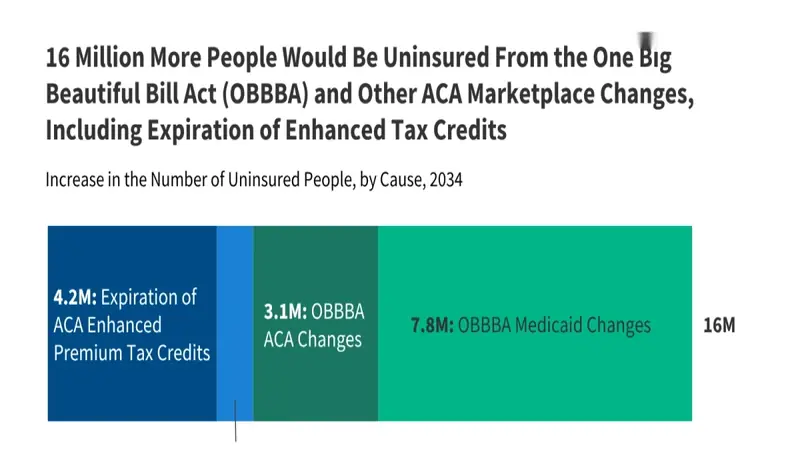
The Congressional Budget Office (CBO) estimates that, taken together, these changes will result in 16 million more uninsured people in the year 2034 than would otherwise be the case, including:
7.8 million more uninsured resulting from Medicaid changes in the One Big Beautiful Bill Act (OBBBA)
3.1 million more uninsured from OBBBA provisions affecting the ACA Marketplaces
900 thousand more uninsured from codifying the recent Trump Administration proposed rule on the ACA Marketplaces. This accounts for only half the effect of the proposed rule; the remaining 900 thousand people becoming uninsured are included in the effects of ACA provisions in the reconciliation package.
4.2 million more uninsured with the expiration of the enhanced premium tax credits, relative to an estimate of a permanent extension of those credits
This would represent a significant increase in the uninsured rate in most states, and it would come after years of declining uninsured rates following implementation of the ACA.
16 Million More People Would Be Uninsured From the One Big Beautiful Bill Act and Other ACA Marketplace Changes, Including Expiration of Enhanced Tax Credits Increase in the Number of Uninsured People, by Cause, 2034ACA Changes in One Big Beautiful Bill accounts for decreases due to the interaction effects.
The Trump administration ACA proposed rule refers to the Marketplace Integrity and Affordability rules proposed by CMS in March 2025. Half of the impact of the proposed rule is considered in the baseline while the other half is included in the ACA Changes portion.Congressional Budget Office (CBO) Estimates
Medicaid Provisions
The Medicaid provisions in the House Reconciliation bill would increase the number of people without health insurance by at least 7.8 million in 2034, according to estimates by the Congressional Budget Office. The increased number of people without health insurance stems from multiple provisions that would reduce federal spending on Medicaid by $793 billion over 10 years and reduce Medicaid enrollment by 10.3 million.
Some of the provisions that would likely cause significant numbers of people to lose health insurance are described below.
Fewer people would be enrolled in Medicaid through the ACA expansion because:
People eligible through the expansion would have to meet new work and reporting requirements.
States would be required to renew eligibility for expansion enrollees at least two times per year and impose new cost sharing requirements.
Fewer states might offer the ACA expansion than might otherwise be the case because the bill would eliminate an added incentive for states to adopt it.
Expansion states would also receive lower federal matching rates if they cover immigrants with state-only funds, regardless of immigration status.
Other provisions would affect all enrollees (not just expansion enrollees):
New requirements added under the Biden administration for states to streamline Medicaid eligibility and enrollment would be delayed until January 1, 2035, which would increase barriers to enroll in and renew Medicaid coverage, especially for older adults and people with disabilities.
The bill would create new requirements for verifying addresses, cross-checking eligibility and data against other sources, and would reduce retroactive coverage from three months to one month.
The bill would eliminate the reasonable opportunity period for verification of immigrant status in all states, during which people receive coverage.
One Big Beautiful Bill Act Changes to the ACA Marketplaces
Proposed Rule Codification
The One Big Beautiful Bill Act codifies policy changes laid out in a recent Trump Administration proposed rule on program integrity. The CBO expects these policy changes to increase the number of uninsured people by 1.8 million by the year 2034. Half of the 1.8 million impact is considered in the baseline while the other half (900K) are accounted for in the impacts of the legislation.
Some of the key changes to the Marketplace from the proposed rule and the One Big Beautiful Bill Act are described below. (More information on additional provisions can be found here.)
Shortens the Open Enrollment Period: In the past few years, the annual open enrollment period has lasted from November 1 to January 15, with some state-based exchanges having longer enrollment periods; the proposed rule and the legislation would end the open enrollment period a month earlier, on December 15.
Restricts the types of Special Enrollment Periods (SEPs): The proposed rule eliminates the year-round enrollment opportunity for people with incomes up to 150% of poverty (the low-income SEP). SEPs allow individuals to enroll in Marketplaces outside the annual open enrollment period.
The legislation would go further than the proposed rule by limiting the ability of all Marketplaces (including SBMs) to provide specific types of SEPs, such as the low-income SEP, that are based on the relationship of people’s income to the poverty line.
Creates a new $5 monthly charge for certain auto-enrollees: Under the proposed rule, enrollees with a zero-dollar premium (after tax credits) who are automatically re-enrolled in Marketplace coverage and do not proactively verify their ongoing eligibility for a fully subsidized plan will face a $5 monthly charge until they actively confirm their eligibility. Legislation includes the same requirement, described as a reduction in advance payment of premium tax credits.
Imposes new documentation requirement for individuals to verify income in specific situations when applying for premium tax credits: The proposed rule and legislation would require individuals to verify their projected income by providing additional documentation where the Internal Revenue Services has no tax return data for the individual for the prior year. Documentation would also be required where IRS data indicates that an applicant’s income for the prior year was below the poverty level.
Restricting coverage for DACA recipients: The proposed rule and legislation disqualify Deferred Action for Childhood Arrivals (DACA) recipients from ACA Marketplace coverage by excluding this group from the definition of “lawfully present.” Additional provisions in the legislation also explicitly prevent DACA recipients from receiving tax credits.
Additional Marketplace Changes
Other provisions in the legislation go beyond codifying the proposed Marketplace integrity rules.
Repayment of excess tax credits: Enrollees whose incomes are different than what they originally estimated must reconcile the amount of tax credit they received with the amount they are determined to be eligible for at the time they file their taxes the following year. This provision would eliminate repayment caps for excess tax credits received.
Appropriating cost sharing reduction (CSR) funding: OBBBA would reinstate government funding for CSRs, effectively ending “silver-loading.” Funding is prohibited for health plans that cover abortion services except when abortion is necessary to save the life of the mother, or if the pregnancy is a result of an act of rape or incest. (For more on CSR appropriation, see this brief ).
Pre-enrollment verification: Requires that income, immigration status, health coverage status, place of residence, family size, and any other information that the Secretary of Health and Human Services deems necessary are verified before coverage. Consumers may still enroll in a plan at full price if they can afford to do so, but they cannot receive premium tax credits or cost-sharing reductions (CSRs) until after they verify their eligibility.
This provision would also effectively end auto-renewals.
Expiration of Enhanced Tax Credits
The CBO projects that 4.2 million more people will be uninsured in 2034 if enhanced ACA tax credits expire. The enhanced premium tax credits were originally passed by Congress in the American Rescue Plan Act (ARPA) and extended under the Inflation Reduction Act (IRA), but they are set to expire at the end of 2025.
The enhanced tax credits both increased the amount of financial help for those already eligible under the ACA and expanded eligibility to those making more than four times poverty ($124,800 for a family of four in 2025), capping premium payments for a benchmark plan at 8.5% of their income.
On average, the enhanced tax credits have reduced premium payments by $705 a year on average for enrollees receiving tax credits.
The enhanced premium tax credits have led to the ACA Marketplace more than doubling in size since 2020. States that President Trump won account for 88% of Marketplace enrollment growth since 2020. In some of these states, like Texas and Georgia, at least 10% of the population in a majority of congressional districts is now enrolled in a Marketplace plan. In Florida, at least 10% of the population in all congressional districts is enrolled in the ACA Marketplace.
The expiration of the enhanced tax credits is expected to cause ACA enrollees’ out-of-pocket premium payments to increase by over 75% on average, with people in some states seeing their payments more than double on average. Lower-income and older enrollees, as well those who live in states that have not expanded Medicaid, are expected to see the most significant premium payment increases.
More On Affordable Care Act Medicaid Private Insurance Uninsured ACA Marketplaces Coverage Federal Budget Premium Support
Also of Interest
Enrollment Growth in the ACA Marketplaces
A Medicaid Per Capita Cap on the ACA Expansion Population: State by State Estimates
Responding to Federal Medicaid Reductions: Which States Are Most at Risk?
Series
Medicaid Watch
Medicaid Watch features the latest policy research, polling, and news about how Medicaid is changing, and the impact of those changes due to the tax and spending cuts law.
More On
Affordable Care Act Medicaid Private Insurance Uninsured ACA Marketplaces Coverage Federal Budget Premium Support View all Topics
© 2026 KFF


Comments 0
Leave a Comment
No comments yet. Be the first to share your thoughts!