
How Present-Day Health Disparities for Black People Are Linked to Past Policies and Events | KFF
Key Takeaways & Highlights
- policies and events and reflect the ongoing impacts of racism at multiple levels, including in systems, structures, policies, and interpersonal interactions.
- Understanding this past and how it shapes present-day disparities can help inform and guide efforts to address them.
- This brief examines how past policies and events are linked to present-day disparities among Black people in health care and health outcomes.
Key Background and Context
The independent source for health policy research, polling, and news.

How many people in America skip medical treatment due to healthcare costs? - USAFacts
Nov 14, 2026Topics Back Topics

Latest Developments and Impact Analysis
Affordable Care Act
Elections
Global Health Policy
Health Costs
Health Information and Trust
HIV/AIDS
Immigrant Health
LGBTQ
Medicaid
Medicare
Mental Health
Patient and Consumer Protections
Public Opinion
Private Insurance
Racial Equity and Health Policy
State Health Policy and Data
Uninsured
Women's Health Policy
FEATURED CONTENT
Health in the 2026 Midterms
Explore all Topics
Policy Research Back Policy Research KFF’s policy research provides facts and analysis on a wide range of policy issues and public programs.
Explore all Policy Research
Polling Back Polling KFF designs, conducts and analyzes original public opinion and survey research on Americans’ attitudes, knowledge, and experiences with the health care system to help amplify the public’s voice in major national debates.
View all Poll Findings
Health News Back Health News KFF Health News is a national newsroom that produces in-depth journalism about health issues and is one of the organization’s core operating programs.
Explore KFF Health News
Data & Features Back Data & Features
FROM THE CEO
From Drew Altman
Beyond the Data
FEATURES
Quick Insights
The Monitor
Health Policy 101
The Business of Health Podcast with Chip Kahn
The Health Wonk Shop
ACA Health Insurance Marketplace Calculator
Employer Health Benefits Survey
Medicaid Budget Survey
POLLING
KFF Health Tracking Poll
Tracking the Public’s Views on the ACA
Polling on Health Information and Trust
Women's Health Survey
FAQS
Health Insurance Marketplace and the ACA
Medicare Open Enrollment
TRACKERS
ACA Preventive Services Tracker
Medicaid Waiver Tracker
Medicaid Work Requirements Tracker
Global Health Budget Tracker
Global COVID-19 Tracker
Peterson-KFF Health System Tracker
DASHBOARDS
Abortion in the U.S.
Key Data on Health Care by Race and Ethnicity
DATABASES
State Health Facts
Custom State Reports
STATE FACT SHEETS
Medicaid Fact Sheets
Mental Health and Substance Use Fact Sheets
State Health Care Snapshots
STATE PROFILES
State Profiles of Dual-Eligible Individuals
State Profiles of Women’s Health
View all Features
For Media Back For Media
Media Contacts
Citations and Reprints
News Releases
Explore all Media Resources
About Back About
About Us
Our People
Our Work
Board of Trustees
Conference Centers
Events
Contact Us
Join Our Team
From CEO Drew Altman
President's Message
Our Standards & Practices
Beyond the Data Columns
View All
About KFF
Follow Us Subscribe
Search
Home Topics Racial Equity and Health Policy
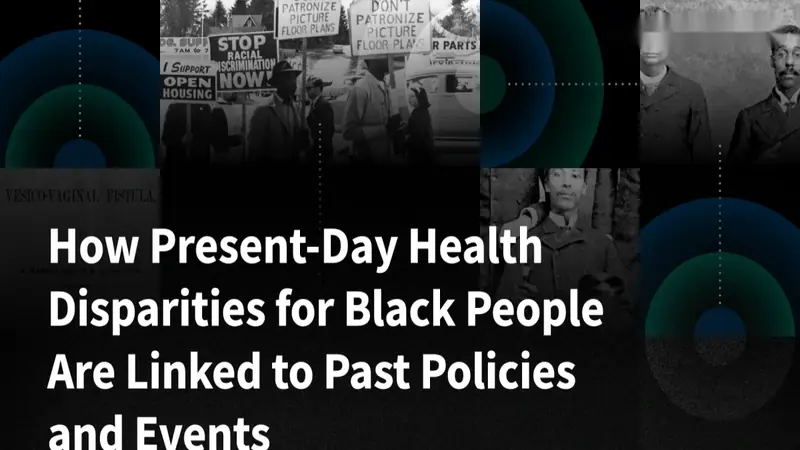
How Present-Day Health Disparities for Black People Are Linked to Past Policies and Events
Authors: Samantha Artiga, Latoya Hill, and Marley Presiado Published: Feb 22, 2024
Add KFF on Google Today’s health and health care disparities are rooted in a long history of U.S. policies and events and reflect the ongoing impacts of racism at multiple levels, including in systems, structures, policies, and interpersonal interactions. Understanding this past and how it shapes present-day disparities can help inform and guide efforts to address them.
It also is important to recognize the resilience of marginalized people in the face of these challenges and disparities and to consider how to build on their strengths by prioritizing community engagement and leadership to mitigate disparities and improve overall health and well-being.
This brief examines how past policies and events are linked to present-day disparities among Black people in health care and health outcomes. It is based on KFF’s interactive timeline of How History Has Shaped Racial and Ethnic Health Disparities and KFF’s 2023 Racism, Discrimination, and Health Survey.
Today, Black people face persistent disparities in health care and health outcomes. These include higher uninsured rates, being more likely to go without care due to cost, and worse reported health status (Figure 1). Their life expectancy is nearly five years shorter compared to White people (72.8 years vs. 77.5 years).
Black infants have a more than two times higher infant mortality rate than White infants (10.6 per 1,000 v. 4.4 per 1,000 as of 2021), and Black people are nearly three times more likely than White people to die due to pregnancy-related reasons (39.9 vs. 14.1 per 100,000 live births between 2017-2019).
Black People Are More Likely To Face Barriers To Health Care And Have Worse Health Outcomes All differences between Black and White people are statistically significant at p




Comments 0
Leave a Comment
No comments yet. Be the first to share your thoughts!