
2025 Employer Health Benefits Survey | KFF
Key Takeaways & Highlights
- 2025 Employer Health Benefits Survey | KFFKey Background and Context The independent source for health policy research, polling, and news.
- The 2025 survey includes 1,862 interviews with non-federal public and private firms.
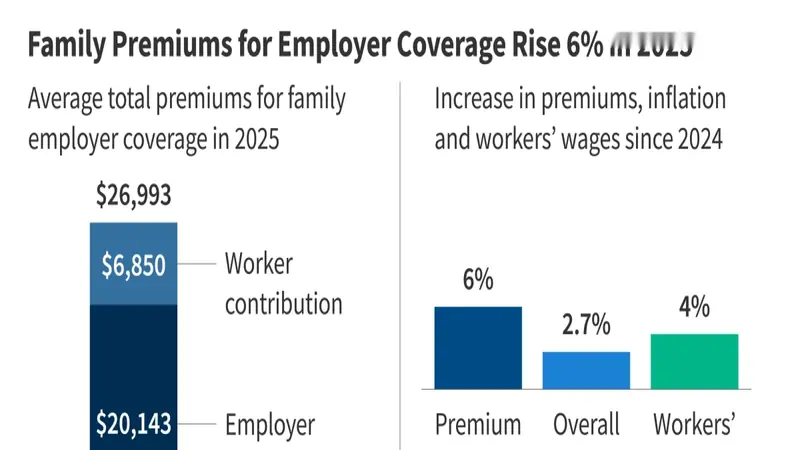
- Annual premiums for employer-sponsored family health coverage reached ,993 this year, 6% higher than in 2024.
Key Background and Context
The independent source for health policy research, polling, and news.
Topics Back Topics

Latest Developments and Impact Analysis
Affordable Care Act
Elections
Global Health Policy
Health Costs
Health Information and Trust
HIV/AIDS
Immigrant Health
LGBTQ
Medicaid
Medicare
Mental Health
Patient and Consumer Protections
Public Opinion
Private Insurance
Racial Equity and Health Policy
State Health Policy and Data
Uninsured
Women's Health Policy
FEATURED CONTENT
Health in the 2026 Midterms
Explore all Topics
Policy Research Back Policy Research KFF’s policy research provides facts and analysis on a wide range of policy issues and public programs.
Explore all Policy Research
Polling Back Polling KFF designs, conducts and analyzes original public opinion and survey research on Americans’ attitudes, knowledge, and experiences with the health care system to help amplify the public’s voice in major national debates.
View all Poll Findings
Health News Back Health News KFF Health News is a national newsroom that produces in-depth journalism about health issues and is one of the organization’s core operating programs.
Explore KFF Health News
Data & Features Back Data & Features
FROM THE CEO
From Drew Altman
Beyond the Data
FEATURES
Quick Insights
The Monitor
Health Policy 101
The Business of Health Podcast with Chip Kahn
The Health Wonk Shop
ACA Health Insurance Marketplace Calculator
Employer Health Benefits Survey
Medicaid Budget Survey
POLLING
KFF Health Tracking Poll
Tracking the Public’s Views on the ACA
Polling on Health Information and Trust
Women's Health Survey
FAQS
Health Insurance Marketplace and the ACA
Medicare Open Enrollment
TRACKERS
ACA Preventive Services Tracker
Medicaid Waiver Tracker
Medicaid Work Requirements Tracker
Global Health Budget Tracker
Global COVID-19 Tracker
Peterson-KFF Health System Tracker
DASHBOARDS
Abortion in the U.S.
Key Data on Health Care by Race and Ethnicity
DATABASES
State Health Facts
Custom State Reports
STATE FACT SHEETS
Medicaid Fact Sheets
Mental Health and Substance Use Fact Sheets
State Health Care Snapshots
STATE PROFILES
State Profiles of Dual-Eligible Individuals
State Profiles of Women’s Health
View all Features
For Media Back For Media
Media Contacts
Citations and Reprints
News Releases
Explore all Media Resources
About Back About
About Us
Our People
Our Work
Board of Trustees
Conference Centers
Events
Contact Us
Join Our Team
From CEO Drew Altman
President's Message
Our Standards & Practices
Beyond the Data Columns
View All
About KFF
Follow Us Subscribe
Search
Home Topics Health Costs
2025 Employer Health Benefits Survey
Published: Oct 22, 2025
Add KFF on Google
News Release: Annual Family Premiums for Employer Coverage Rise 6% in 2025, Nearing $27,000, with Workers Paying $6,850 Toward Premiums Out of Their Paychecks
Section: 0 / 0
Overview to Overview
Note: The 2026 Employer Health Benefits Survey will be released on Thursday, October 22, 2026.This is the 27th annual Employer Health Benefits Survey. As in years past, the survey examines trends in employer-sponsored health coverage, including premiums, employee contributions, cost-sharing provisions, offer rates, wellness programs, and employer practices.
This year we asked employers detailed questions about their provider networks, approaches to primary care, menopause support benefits, and coverage for GLP-1 agonists for weight loss, as well as which overall factors they believe have contributed to premium growth. The 2025 survey includes 1,862 interviews with non-federal public and private firms.
Annual premiums for employer-sponsored family health coverage reached $26,993 this year, 6% higher than in 2024. On average, workers contributed $6,850 toward the cost of family coverage. The average deductible among covered workers in a plan with a general annual deductible was $1,886 for single coverage.
Survey results are released in several formats, including a full report with downloadable tables on a variety of topics, a summary of findings, and an article published in the journal Health Affairs.
Key Resources
The peer-reviewed journal Health Affairs has published an article with key findings from the survey (subscription required): Health Benefits In 2025: Premiums Rise 6 Percent, Larger Employers Increase Coverage of GLP-1 Drugs For Weight Loss.
This interactive graphing tool allows users to look at changes in premiums and worker contributions for covered workers at different types of firms over time: Premiums and Worker Contributions Among Workers Covered by Employer-Sponsored Coverage, 1999-2025.
Key slides from the 2025 Employer Health Benefits Survey are here.
Employer Health Benefits Surveys from 1998–2024 are available here. Please note that historic survey reports have not been revised with methodological changes.
2025 Tables By Section
Section 1
Section 2
Section 3
Section 4
Section 5
Section 6
Section 7
Section 8
Section 9
Section 10
Section 11
Section 12
Section 13
Summary of Findings
Methods
Contact Us
For questions about the Employer Health Benefits Survey, please visit Contact Us and choose “TOPIC: Health Costs.”
Researchers may request a public use dataset by completing a data use agreement (available here).
Summary of Findings to Summary of Findings
Employer-sponsored insurance covers 154 million people under the age of 651. To provide a current snapshot of employer-sponsored health benefits, KFF conducts an annual survey of private and non-federal public employers with ten or more workers. This is the 27th Employer Health Benefits Survey (EHBS) and reflects employer-sponsored health benefits in 2025.
HEALTH INSURANCE PREMIUMS AND WORKER CONTRIBUTIONS
The average annual premiums for employer-sponsored health insurance in 2025 are $9,325 for single coverage and $26,993 for family coverage. Over the last year, the average single premium increased by 5% and the average family premium increased by 6%. Comparatively, there was an increase of 4% in workers’ wages and inflation of 2.7%2 3.
Over the last five years, the average premium for family coverage has increased by 26%, compared to a 28.6% increase in workers’ wages and inflation of 23.5% [Figure A, Figure B].
The average premium for firms with 10 to 199 workers is comparable to the average premium at larger firms for covered workers with single coverage ($9,211 and $9,361) but lower for family coverage ($26,054 vs. $27,280). The average premiums for covered workers in high-deductible health plans with a savings option (HDHP/SO) are lower than the overall average premiums for both single coverage ($8,620) and family coverage ($25,379).
In contrast, average premiums for covered workers enrolled in PPOs are higher than the overall average premiums for both single ($9,818) and family coverage ($28,272).
Premiums also differ with firm characteristics. The average premiums for both single and family coverage are relatively low for covered workers at private for-profit firms and relatively high for covered workers in private not-for-profit firms. The average premiums for covered workers at firms with larger shares of older workers (where at least 35% of the workers are age 50 or older) are higher than the average premiums for covered workers at firms with smaller shares of older workers for both single ($9,599 vs. $9,068) and family ($27,699 vs. $26,332) coverage.
The average premiums for covered workers at firms with relatively large shares of higher-wage workers (where at least 35% of workers earn $80,000 a year or more) are higher than the average premiums for covered workers at firms with smaller shares of higher-wage workers for both single ($9,600 vs. $9,133) and family ($27,957 vs. $26,313) coverage [Figure C].
Figure A: Average Annual Worker and Employer Premium Contributions for Family Coverage, 2015, 2020, and 2025
Figure B: Average Annual Increases in Premiums for Family Coverage Compared to Other Indicators, 2015-2025
Figure C: Average Annual Premiums and Worker Contributions for Family Coverage, by Firm Characteristics, 2025
Most covered workers contribute to the cost of the premium directly. On average, covered workers contribute 16% of the premium for single coverage and 26% of the premium for family coverage, similar to the percentages contributed in 2024. The average contribution rates for single coverage are the same for covered workers in firms with 10 to 199 workers and in larger firms (16%) but the average contribution rate for family coverage is higher for covered workers in firms with 10 to 199 workers than for those in larger firms (36% vs. 23%).
On average, covered workers at private, for-profit firms have relatively high premium contribution rates and covered workers in public firms have relatively low contribution rates for both single coverage and family coverage.
Twenty-nine percent of covered workers at firms with 10 to 199 workers are enrolled in a plan where the employer pays the entire premium for single coverage, compared with only 7% of covered workers at larger firms. In contrast, 29% of covered workers at firms with 10 to 199 workers are in a plan where they must contribute more than half of the premium for family coverage, compared to 5% of covered workers at larger firms [Figure D].
The average annual contribution amounts for covered workers are $1,440 for single coverage, similar to the amount last year, and $6,850 for family coverage, higher than the amount last year. The average contribution amount for family coverage for covered workers at firms with 10 to 199 workers ($8,889) is higher than the amount for covered workers at larger firms ($6,227) [Figure C].
Eleven percent of covered workers, including 28% of covered workers at firms with 10 to 199 workers, are in a plan with a worker contribution of $12,000 or more for family coverage.
Figure D: Distribution of Percentage of Premium Paid by Covered Workers for Single and Family Coverage, by Firm Size, 2025
PLAN ENROLLMENT
PPOs continue to be the most common plan type in 2025. Forty-six percent of covered workers are enrolled in a PPO, 33% are enrolled in a high-deductible plan with a savings option (HDHP/SO), 12% are enrolled in an HMO, 9% are enrolled in a POS plan, and less than one percent are enrolled in a conventional (also known as an indemnity) plan [Figure E].
Figure E: Distribution of Health Plan Enrollment for Covered Workers, by Plan Type and Firm Size, 2021 and 2025
SELF FUNDING
Many firms – particularly larger firms – have self-funded health plans, which means that they pay for the health services of enrollees directly from their own funds rather than through the purchase of health insurance. Sixty-seven percent of covered workers, including 27% of covered workers at firms with 10 to 199 workers and 80% at larger firms, are enrolled in plans that are self-funded.
Thirty-seven percent of covered workers in firms with 10 to 199 workers are covered by a level-funded plan, similar to the percentage in 2024. Level-funded arrangements combine a relatively small self-funded component with stop-loss insurance, which limits the employer’s liability and transfers a substantial share of risk to insurers.
These plans have the potential to meaningfully affect competition in the small group market because, unlike insured plans, they use health status in rating and underwriting, and are not required to provide all of the essential health benefits that are mandatory for insured plans.
EMPLOYEE COST SHARING
Eighty-eight percent of workers with single coverage have a general annual deductible that must be met before most services are paid for by the plan, the same percentage last year (88%).
The average deductible amount in 2025 for workers with single coverage and a general annual deductible is $1,886, similar to last year. The average deductible for covered workers at firms with 10 to 199 workers ($2,631) is higher than the average deductible at larger firms ($1,670). For covered workers with an annual deductible, the average deductible for single coverage has increased 17% over the last five years and 43% over the last 10 years.
Thirty-four percent of covered workers in 2025 are in a plan with a general annual deductible of $2,000 or more for single coverage, similar to the percentage (32%) last year. Over half (53%) of covered workers in firms with 10 to 199 workers are in such a plan, compared with 28% of covered workers in larger firms.
The share of covered workers in a plan with a general annual deductible of $2,000 or more for single coverage has increased 32% over the last five years and 77% over the last ten years [Figure F].
Some workers in health plans with high deductibles also receive contributions to savings accounts from their employers. These contributions can be used to reduce cost sharing amounts. Thirty-three percent of covered workers in an HDHP with a Health Reimbursement Arrangement (HRA), and 3% of covered workers in a Health Savings Account (HSA)-qualified HDHP receive an account contribution for single coverage that is greater than or equal to their deductible amount.
Additionally, 19% of covered workers in an HDHP with an HRA and 10% of covered workers in an HSA-qualified HDHP receive account contributions that, if applied to their deductible, would reduce their personal annual liability to less than $1,000.
In addition to any general annual deductible they may have, most covered workers also pay a portion of the cost of care when they use health care services, typically a copayment (a fixed dollar amount) or coinsurance (a percentage of the covered amount). For physician office visits, the average copayment for a primary care visit is $27, similar to the amount last year, and the average copayment for a visit to a specialist is $45, higher than the amount last year.
The average coinsurance rate is 19% for both primary care and specialist visits, similar to the percentages last year.
When admitted to the hospital, 65% of covered workers have coinsurance requirements, 11% have a copayment, and 8% have both a copayment and coinsurance requirement. The average coinsurance rate for a hospital admission is 20% and the average copayment amount is $313. The cost sharing requirements for outpatient surgery follow a similar pattern to those for hospital admissions, although the average copayment amount for outpatient surgery is lower ($186).
Virtually all covered workers are in plans with an annual limit on in-network cost sharing (called an out-of-pocket maximum) for single coverage, although these limits vary significantly. Among covered workers in plans with an out-of-pocket maximum for single coverage, 12% are in a plan with an out-of-pocket limit of $2,000 or less, while 21% are in a plan with a limit above $6,000.
Figure F: Percentage of Covered Workers Enrolled in a Plan With a General Annual Deductible of $2,000 or More for Single Coverage, by Firm Size, 2009-2025
AVAILABILITY OF EMPLOYER-SPONSORED COVERAGE
Sixty-one percent of firms with 10 or more workers offer health benefits to at least some of their workers, similar to the percentage last year (65%). As explained in the Methods, the 2025 survey sample was limited to firms with 10 or more employees, resulting in a higher overall offer rate than previously published estimates. Firms with 200 or more workers are much more likely than smaller firms to offer health benefits (97% vs. 59%).
Because most firms are small, the overall offer rate can fluctuate over time, as estimates for smaller firms tend to vary considerably from year to year. Most workers, however, work for larger firms, where offer rates are higher and much more stable. Among firms with 200 or more workers, 96% of firms with 200 to 999 workers, and over 99% of firms with 1,000 or more workers, offer health benefits to at least some of their workers.
Overall, 91% of workers are employed by a firm that offers health benefits to at least some of its workers. This percentage is similar to the percentages five years ago (92%).
Even in firms offering health benefits, many workers are not covered by health benefits provided by the firm. Some are not eligible to enroll (due to factors such as waiting periods or part-time or temporary work status), while others who are eligible choose not to enroll (they may feel the coverage is too expensive, or they may be covered through another source).
Additionally, some firms provide incentives for workers or spouses of workers not to enroll in their plans, or to enroll in a spouses’ plan. On average, at firms that offer coverage, 80% of workers are eligible. Among eligible workers, 76% take up the firm’s offer. Overall, 61% of workers at firms that offer health benefits are enrolled in that coverage.
The coverage rate varies with workforce characteristics. Among workers at firms offering health benefits, those working for firms with a relatively large share of younger workers are less likely to be covered by their own firm than workers in firms with a smaller share of younger workers (39% vs. 64%) and those working at firms with a relatively large share of lower-wage workers are less likely to be covered by their own firm than workers at firms with a smaller share of lower-wage workers (43% vs. 64%)4 The share of workers employed at public organizations covered by their own employer (72%) is higher than the shares of workers covered that are employed at private for-profit firms (59%), or private non-for-profit firms (60%).
Across firms that offer health benefits and firms that do not, 55% of workers are covered by a health plan offered by their employer, similar to the percentage last year (57%).
HEALTH PROMOTION AND WELLNESS PROGRAMS
Many firms sponsor programs to help workers identify health issues and manage chronic conditions. These programs include health risk assessments, biometric screenings, and health promotion programs.
Health Risk Assessments. Among firms offering health benefits, 35% of firms with 10 to 199 workers and 53% of larger firms provide workers the opportunity to complete a health risk assessment. Among large firms that offer a health risk assessment, 53% use incentives or penalties to encourage workers to complete the assessment, similar to the percentage last year.
Biometric Screenings. Among firms offering health benefits, 22% of firms with 10 to 199 workers and 43% of larger firms provide workers the opportunity to complete a biometric screening. Among large firms with a biometric screening program, 62% use incentives or penalties to encourage workers to complete the assessment, similar to the percentage last year.
Health and Wellness Promotion Programs. Many firms offering health benefits offer programs to help workers identify and address health risks and unhealthy behaviors. Fifty-six percent of firms with 10 to 199 workers and 83% of larger firms offer a program in at least one of these areas: smoking cessation, weight management, and behavioral or lifestyle coaching.
The percentage of both smaller firms and larger firms offering one of these programs are similar to the percentages last year (61% and 79%, respectively).
GLP-1 DRUG COVERAGE FOR WEIGHT LOSS
GLP-1 (Glucagon-like peptide-1) agonists, used to help control blood sugar levels in people with type 2 diabetes and certain other conditions, have also been shown to be an effective drug to help people lose weight. The high cost of these drugs, h



Comments 0
Leave a Comment
No comments yet. Be the first to share your thoughts!